Can Two Probes Control a Relay? | Water Conductivity & Transistor Driver
Water containing dissolved ions conducts between two probes. A transistor stage can use the small sensing current to control a relay coil.
Watch & exploreExplore one engineering idea at a time. Watch a short lesson, read the key concepts and test your understanding before your next interview, project or class.
Video · Key ideas · Check your understanding
Water containing dissolved ions conducts between two probes. A transistor stage can use the small sensing current to control a relay coil.
Watch & exploreA compatible interface lets a smoke alarm signal an additional light. The alarm handles smoke detection and its primary warning, while the accessory controls the light.
Watch & exploreA separate high-level float can interrupt tank filling if the normal level control fails. A latched trip keeps the fill command disabled after the surface drops below the float.
Watch & exploreA robot arm’s workspace contains the positions its tool can reach under its joint limits. Some positions allow only a restricted set of tool orientations.
Watch & exploreA transfer pump needs demand at the receiving tank, room for more liquid, and enough liquid in the source tank. These conditions address different reasons to start or stop.
Watch & exploreRotations change the directions of a frame’s axes. A translation expressed in those axes can therefore produce different final positions depending on when the rotation occurs.
Watch & exploreTwo arms sharing a workcell need trajectories that account for where both robots will be at each instant. Their links, tools and carried objects all occupy space.
Watch & exploreA sump pump starts at a high water level and runs until the level falls to a lower stop point. The water volume between those levels reduces rapid switching.
Watch & exploreA BLE tag sends radio advertisements that an ESP32 can observe. A separation reminder can use a filtered signal trend and the time since the last advertisement to decide when to alert.
Watch & exploreHeading angles wrap at a full turn. A controller that subtracts them directly can command almost a full revolution when the goal is only two degrees away.
Watch & exploreA current-carrying conductor in a magnetic field experiences a force. In a brushed DC motor, forces on the armature conductors produce shaft torque.
Watch & exploreAn ESP32 can use relative humidity from an SHT31 to decide when to run a fan. A higher start threshold and lower stop threshold prevent repeated toggling near the setpoint.
Watch & exploreA path describes the geometry a robot should follow. A trajectory assigns times to positions along that path, defining how the motion unfolds.
Watch & exploreLocalization accuracy describes agreement with a reference pose. Precision describes the spread of repeated estimates under similar conditions.
Watch & exploreA robot can be clear of obstacles at both ends of a move and still hit something between them. Collision checking must account for the swept volume of the robot.
Watch & exploreA BH1750 measures illuminance in lux. An ESP32 can integrate those readings over time to compare daily exposure at a fixed sensor position.
Watch & exploreA single-pole double-throw relay moves its common contact between two branches. Grouping four lamps into two banks lets the relay select which bank is connected.
Watch & exploreReversing the armature voltage on a permanent-magnet brushed DC motor reverses the driven current and torque direction once the electrical transient settles. The rotor’s inertia influences how quickly the shaft changes direction.
Watch & exploreWireless sensor links differ in data rate, energy demand and network structure. A phone accessory, a building mesh and a field station impose different communication requirements.
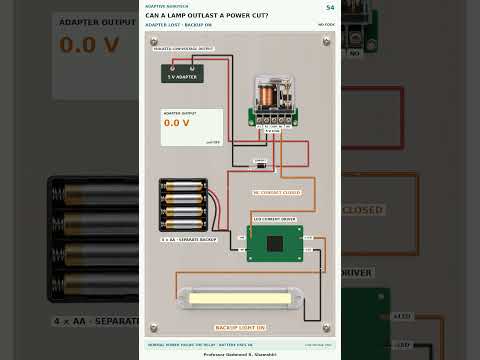
Watch & exploreA transfer relay can select battery power for a lamp when its normal supply fails. The useful backup time depends on the battery’s available energy and the lamp’s power draw.
Watch & exploreA passive NFC tag can carry a link to a wallet return-contact page. A nearby compatible phone energizes the tag during a scan and reads its stored data.
Watch & exploreA Raspberry Pi can log DS18B20 temperature readings with timestamps and identify intervals outside a chosen range. Both the temperature reached and the time spent outside the range matter.
Watch & exploreA pressure difference across a filter can rise as material accumulates. An ESP32 can record that change and latch a trip when a chosen limit is reached.
Watch & exploreA joystick supplies two analog commands for pan and tilt. The ESP32 reads each axis and sends the corresponding servo pulse settings to a PCA9685 over I²C.
Watch & explore