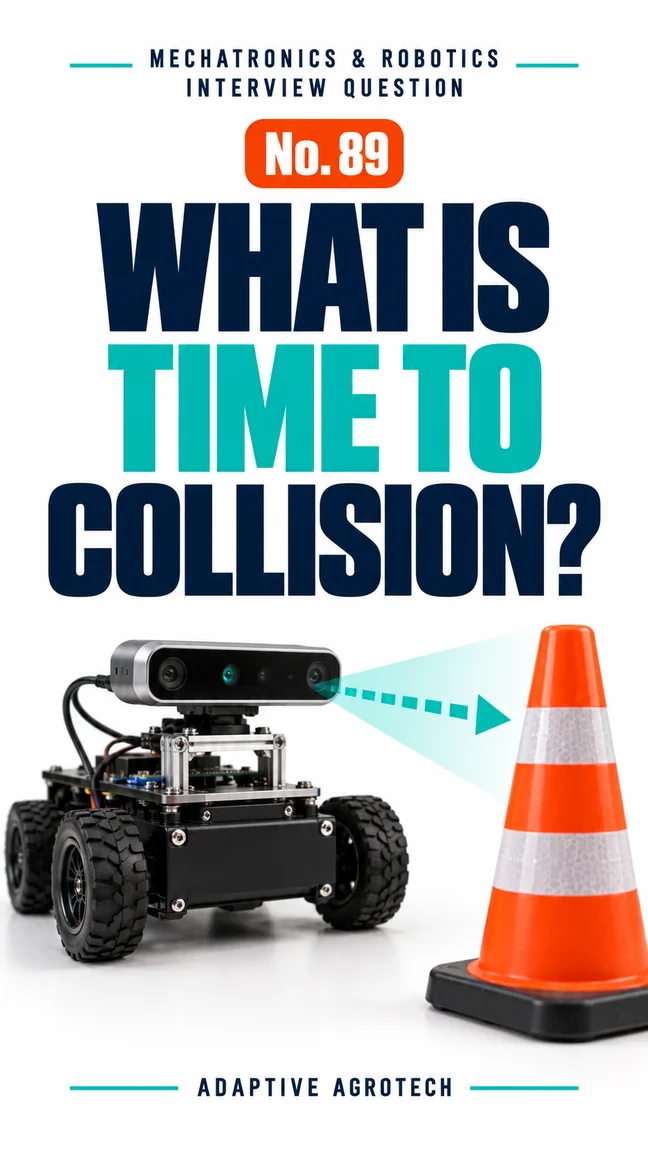
What is Time to Collision?
Time to collision predicts the time remaining before contact under an assumed motion model. Straight closing motion permits clearance divided by closing speed, while crossing trajectories require geometry and uncertainty to be considered.
The key idea
Time to collision estimates when contact would occur if the assumed motion continues. Distance alone is insufficient because closing speed and object geometry also matter. For straight motion toward a wall, free clearance divided by closing speed gives a simple estimate: three meters at one meter per second yields three seconds. Crossing paths require the full relative geometry and a check that contact actually occurs. A small predicted time can trigger stopping, but acceleration, measurement delay, and uncertainty can change the real outcome and the interpretation of the estimate.
What to remember
- Combine clearance, relative speed, and geometry.
- For straight closing motion, divide clearance by closing speed.
- Account for acceleration, delays, and uncertainty.
Check your understanding
What is the simple time to collision for 3 m clearance at 1 m/s closing speed?
Show the explanation
Three seconds, assuming the closing motion stays constant.