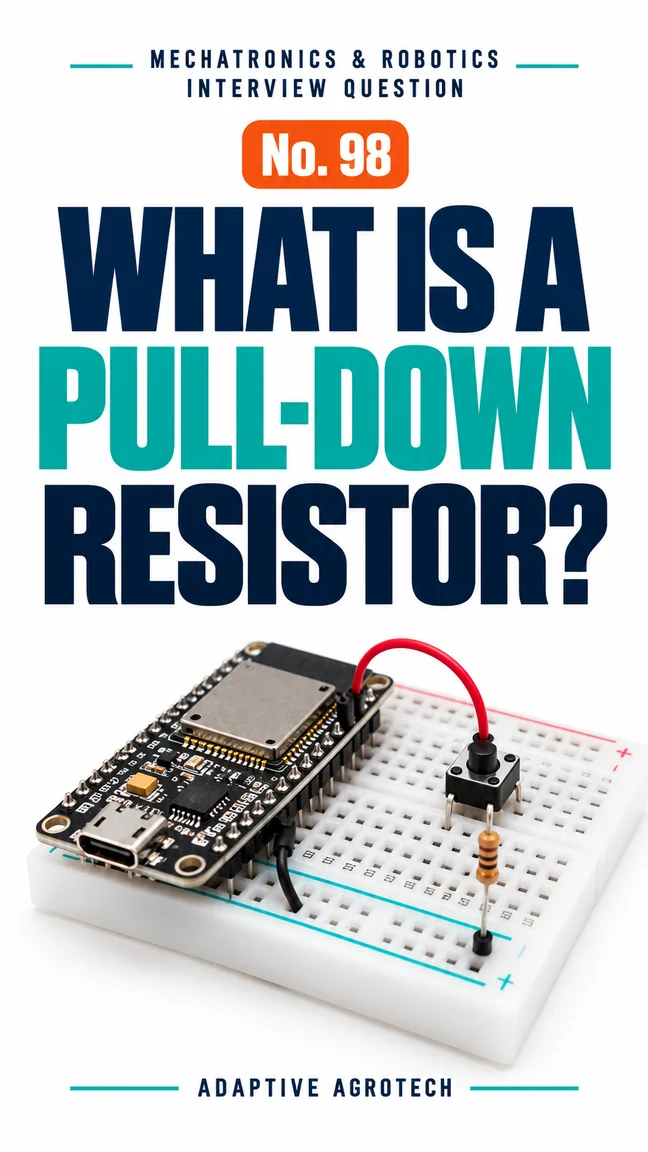
What is a Pull-Down Resistor?
A pull-down resistor holds an undriven digital input low and limits current when a switch drives it high. Reliable selection depends on input leakage, logic thresholds, and the circuit’s susceptibility to noise.
The key idea
An undriven digital pin can respond unpredictably to electrical noise. Connecting a resistor from the input to ground establishes a known low idle state. A switch from that node to the logic supply then raises the input when pressed, while the resistor limits the current flowing to ground. This arrangement can provide an active high start button for a robot. Resistance selection should account for input leakage and valid logic thresholds. If the pull-down is too weak, nearby electrical noise can overcome the intended low level and cause unwanted transitions.
What to remember
- Connect a resistor from the input to ground.
- A supply connected switch produces an active high signal.
- Check leakage, thresholds, and noise sensitivity.
Check your understanding
What is the idle level of an input with a pull-down?
Show the explanation
Logic low when no other circuit drives the node.