These questions support Module 5 and future interviews in firmware, embedded Linux, robotics, IoT, automotive, industrial control, and mechatronics. Strong answers connect hardware features to timing, safety, testability, and lifecycle rather than naming a favorite development board.
Questions
Q1. Why is a Raspberry Pi Pico not an embedded Linux computer?
Q2. Compare an 8-bit AVR, RP2040, ESP32-S3, STM32G4/H7-class device, and nRF52840 for representative applications.
Q3. Why is CPU clock frequency an inadequate basis for MCU selection?
Q4. What is DMA, and what new failure modes can it introduce?
Q5. Why should an ISR be short and bounded?
Q6. Does declaring a shared variable volatile make access thread-safe? Explain.
Q7. Compare a non-blocking superloop with an RTOS design.
Q8. Define period, latency, jitter, execution time, deadline, and worst-case execution time.
Q9. What functions should remain operational if the Linux computer crashes in a mobile robot?
Q10. Why does a byte stream require framing even when each sender uses one write call per message?
Q11. Compare delimiter, length-prefix, fixed-length, and COBS-style framing.
Q12. What should a versioned MCU protocol specify beyond the byte layout?
Q13. What does a sequence number reveal that a CRC does not? What does a CRC reveal that a sequence number does not?
Q14. Why can a valid CRC not authenticate a motor command?
Q15. When an acknowledgement is received, what exactly has been proven?
Q16. How can a watchdog be refreshed incorrectly?
Q17. What should happen to actuator outputs immediately after MCU reset?
Q18. Compare discard-oldest and discard-newest buffer policies.
Q19. A 20 ppm clock is used without synchronization. Estimate one day of possible accumulated error at that rate.
Q20. Why should control durations use a monotonic counter rather than wall-clock time?
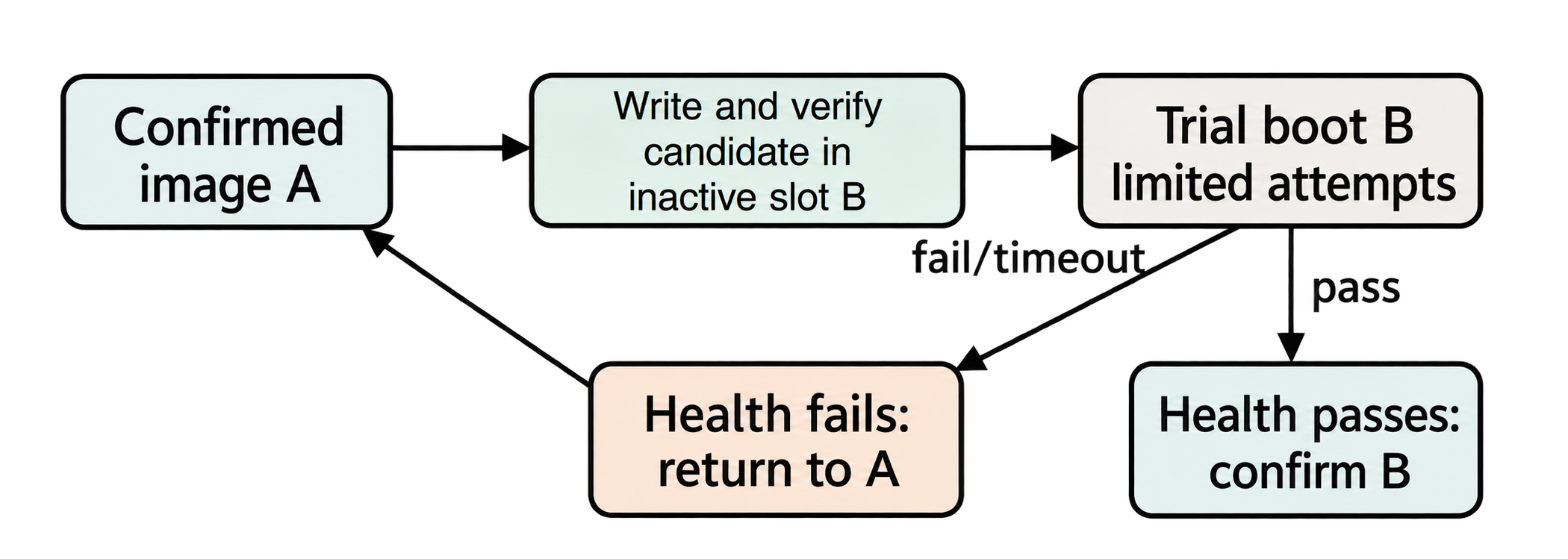
Q21. Describe a power-loss-safe dual-image firmware update.
Q22. An MCU resets whenever Wi-Fi transmits. Give a layered investigation.
Q23. A protocol works on the bench but corrupts frames near a motor. What physical and software evidence would you collect?
Q24. Design a test proving that loss of the Linux–MCU connection leads to a safe and observable state.
Answers and discussion
A1. Pico boards use an RP-series microcontroller and execute firmware from flash with limited SRAM. They do not provide the processor/memory-management/storage architecture required for ordinary Raspberry Pi OS or desktop/server Linux.
A2. AVR suits simple low-cost control and sensing; RP2040 offers dual cores and PIO for custom deterministic digital I/O; ESP32-S3 adds Wi-Fi/BLE, USB, and higher connected/ML capability; STM32G4/H7 classes support advanced control or high compute and rich peripherals; nRF52840 is strong for low-power BLE/802.15.4. Exact part and system requirements determine the answer.
A3. Peripherals, memory, DMA, timers, ADC quality, radio, latency, power, temperature, security, tools, lifecycle, and simultaneous pin mapping may dominate. Frequency does not state work per cycle or deterministic I/O capability.
A4. DMA transfers data between peripheral and memory without CPU work per item. Incorrect lengths, stale buffers, ownership races, cache incoherency, overwriting unread data, and premature reuse can corrupt results.
A5. A long ISR delays equal or lower-priority interrupts, increases jitter, risks missed events, and makes worst-case timing difficult. Capture essential state, signal deferred work, and return.
A6. No. volatile affects compiler access but does not make read-modify-write atomic, protect multi-field invariants, or provide complete synchronization. Use atomic operations, critical sections, queues, or RTOS/architecture primitives.
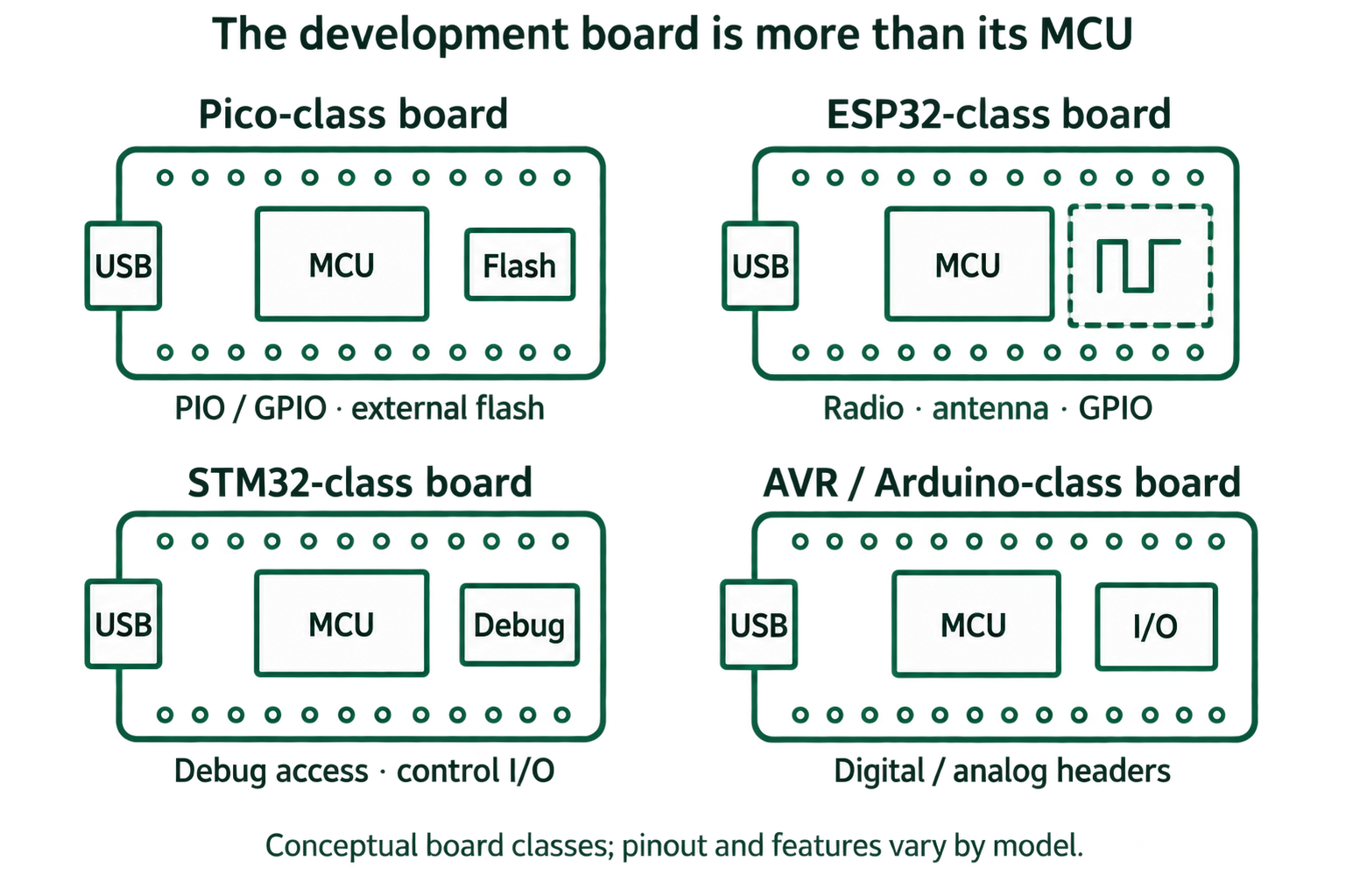 Figure 5.1.
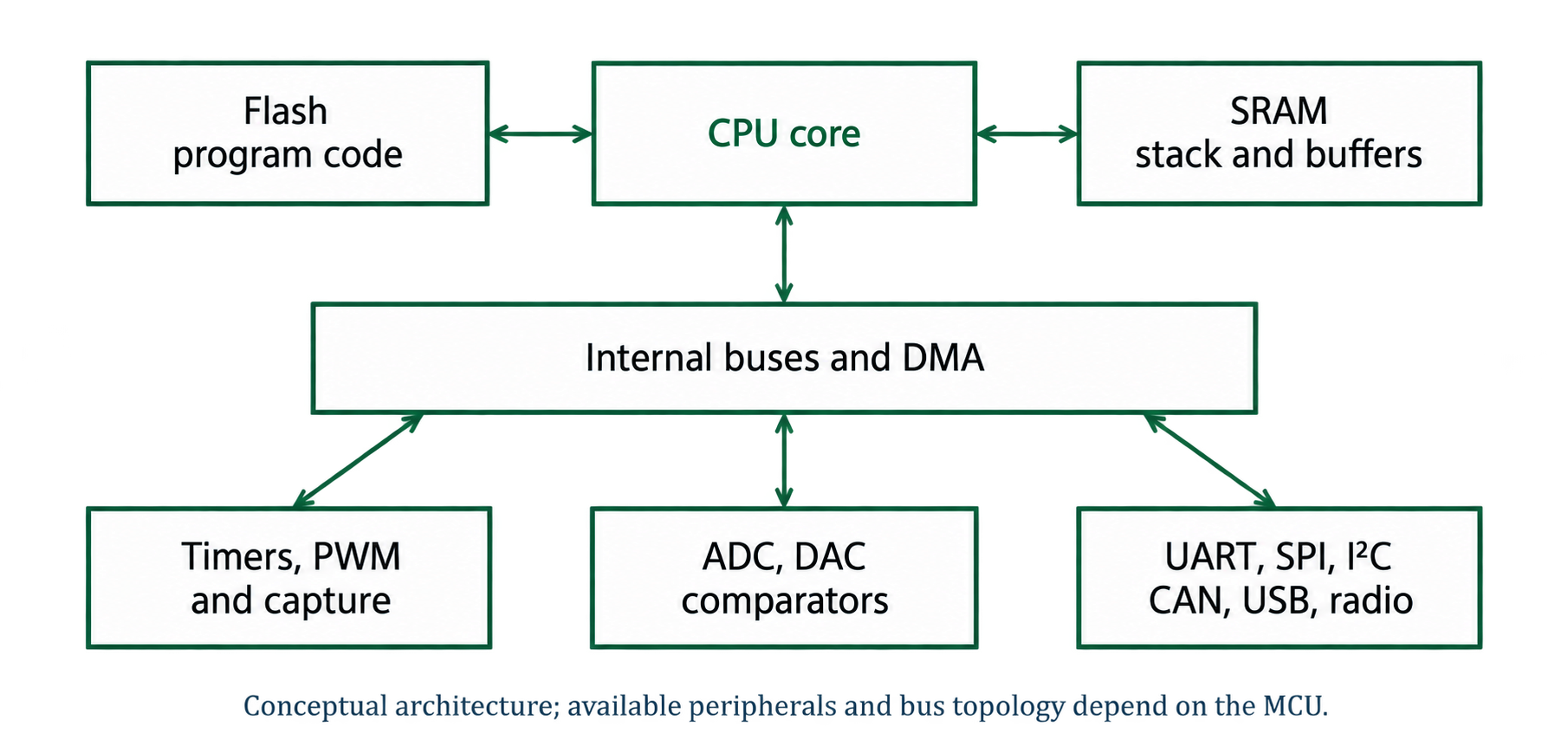 Figure 5.2.