Block 1 · 12:00–12:50 · Wireless Fundamentals, Radio Propagation, and Performance Measurement
Wireless Acquisition, LoRa Peer-to-Peer,
and MQTT
6.1 The Wireless Design Space
No radio technology simultaneously maximizes range, throughput, battery life, low latency, reliability, small antenna size, unlimited fleet capacity, global regulatory compatibility, and low cost. Selection begins with application requirements:
- payload size and reporting or command frequency;
- maximum useful latency and tolerated jitter;
- required delivery probability and acceptable data age;
- number and spatial density of nodes;
- movement, orientation, obstruction, vegetation, buildings, and terrain;
- battery capacity, sleep requirement, and expected service life;
- uplink versus downlink traffic and acknowledgement needs;
- spectrum rules, coexistence, security, and deployment jurisdiction; and
- installation, antenna, gateway, subscription, and maintenance cost.
|
Technology class |
Typical strength | Typical limitation | Representative role |
|---|---|---|---|
| Wi-Fi | High throughput and IP integration |
Power, coverage, association, congestion |
Cameras, local gateways, firmware transfer |
| Bluetooth LE | Low-power personal/local connectivity |
Shorter practical coverage and small payload workflows |
Commissioning, wearables, local sensors |
| IEEE 802.15.4-class mesh |
Low-power networked nodes |
Mesh planning, latency, coexistence, stack complexity |
Building or greenhouse sensor networks |
| Cellular | Wide-area managed infrastructure |
Subscription, power, coverage, modem complexity |
Remote gateways and mobile assets |
| GNSS | Broadcast positioning and time rather than user data networking |
Sky visibility, multipath, receiver energy |
Position/time source for mobile and field nodes |
| LoRa peer-to-peer |
Long range at low data rate with direct control |
Designer owns networking, security, access, and scaling |
Private experimental links and simple telemetry |
| LoRaWAN | Standardized LPWAN network architecture |
Network/server/ device provisioning and regional constraints |
Large managed sensor deployments; covered next module |
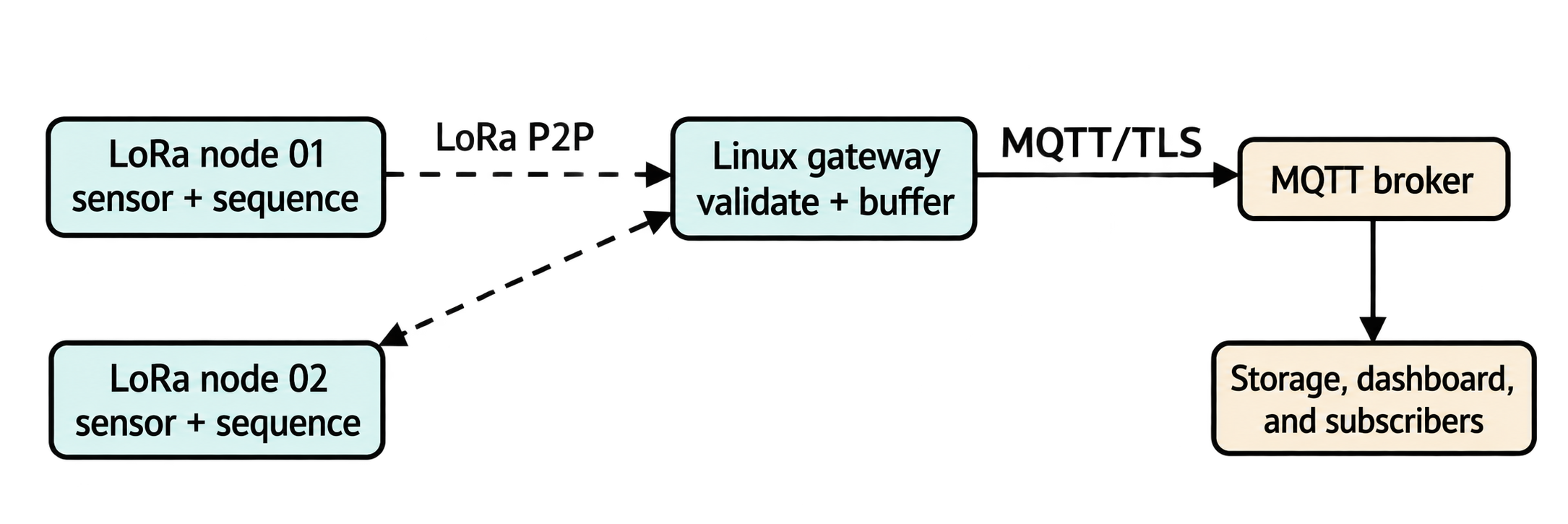
This chapter uses LoRa in direct peer-to-peer mode and MQTT on the IP side of a Linux gateway. LoRaWAN is not simply peer-to-peer LoRa with a different payload; it defines a network architecture, device class, activation, session security, gateways, and network/application server roles. Those topics and private-cloud integration belong to Module 7.
6.2 Radio Propagation and the Link Budget
A link budget accounts for transmit power, gains, losses, and receiver requirement. In decibel units,
where Pr and Pt are received and transmitted power in dBm, Gt and Gr are antenna gains in dBi, and the L terms are losses in dB. The loss terms cover propagation, cable, connector, mismatch, polarization, body, enclosure, and other effects without double counting.
The nominal link margin is
where Srx is receiver sensitivity for the selected modulation and data-rate configuration. Positive predicted margin is necessary but does not guarantee a reliable field link. Fading, interference, manufacturing variation, antenna detuning, orientation, and noise-floor changes require additional margin.
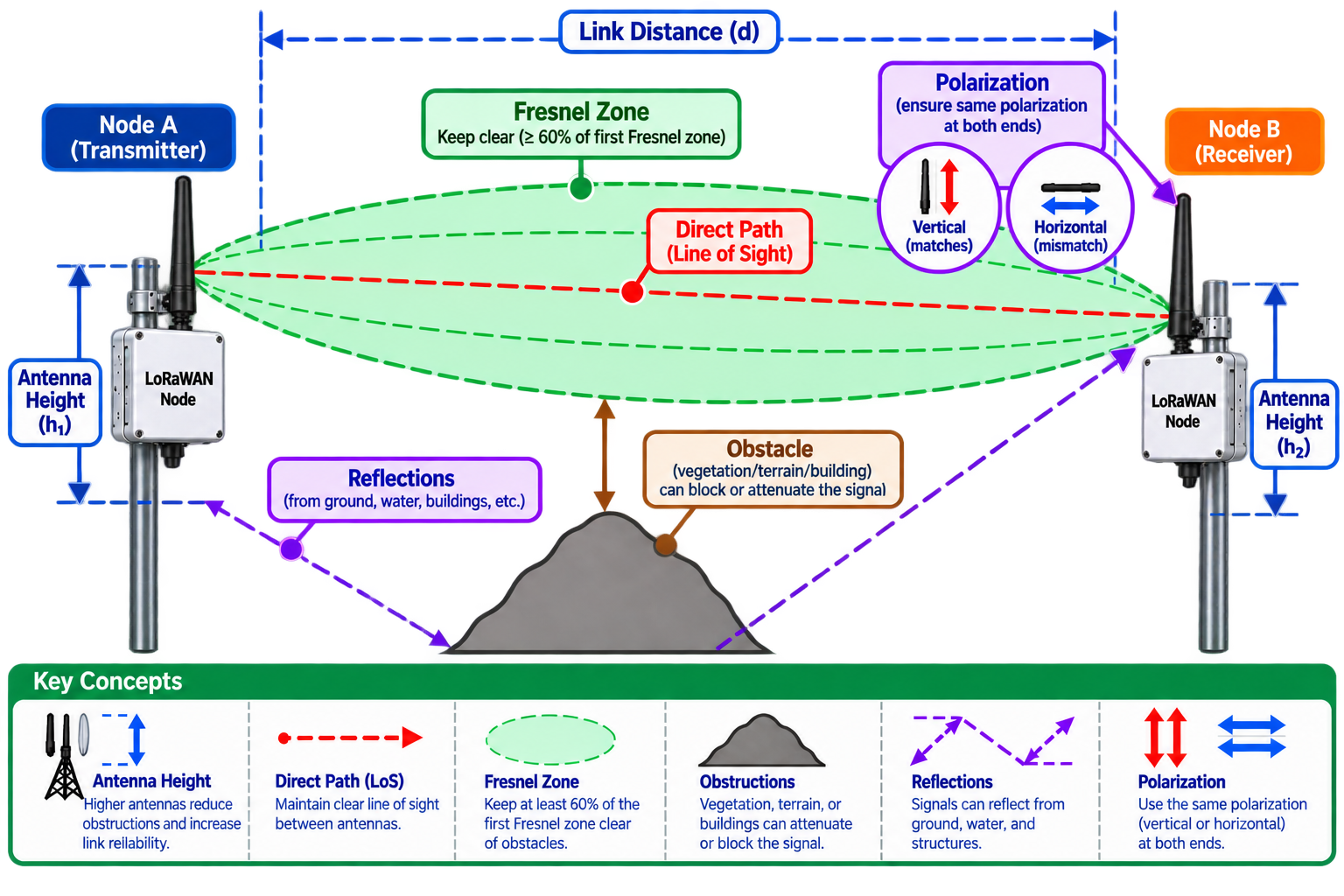
where d is distance and λ wavelength. Real agricultural, indoor, and urban channels differ substantially from free space due to reflection, diffraction, absorption, scattering, and partial obstruction of the Fresnel zone.
6.3 Antennas and Installation Reality
An antenna must be appropriate for frequency, impedance, ground plane, enclosure, cable, and mounting. Antenna gain redistributes radiation; it does not create energy. Regulatory limits may constrain effective radiated power, so adding antenna gain may require reducing transmitter output.
Common practical failures include:
- operating without an antenna or with the wrong frequency antenna;
- loose, damaged, or incompatible miniature RF connectors;
- antenna detuning by metal, batteries, wet vegetation, soil, or enclosure material;
- cross-polarization between transmitter and receiver;
- antenna placement close to digital noise sources or power converters;
- long lossy coax cable that removes expected antenna benefit; and
- locating both antennas close to the ground, machinery, or obstructions.
Never transmit from hardware that requires a matched antenna while the RF output is open or incorrectly terminated. Follow the radio and module manufacturer’s requirements.
6.4 Measuring Wireless Performance
Received signal-strength indication (RSSI) estimates power at the receiver. Signal-to-noise ratio (SNR) compares desired signal to noise within the receiver’s relevant bandwidth. Packet delivery ratio is
provided the transmitted count is known for the same observation interval and each transmitted packet is counted at most once in the numerator. Count duplicate receptions separately. State whether the denominator counts radio attempts or unique application messages; retries give different values for those two metrics. Packet error or loss, latency distribution, duplicates, and sequence gaps provide application-level evidence.
RSSI alone is insufficient. A strong interfering signal can produce high observed energy and poor packet reception. LoRa can sometimes decode signals at negative reported SNR, depending on configuration. Device-reported RSSI and SNR are estimates and should be compared cautiously across different chipsets.
A credible range test controls or records frequency, configuration, firmware, payload, antennas, height, orientation, location, movement, weather, battery voltage, interference conditions, transmitted sequence count, and observation time. Test repeated spatial points and both directions. A single maximum-distance packet is not a coverage result.
| Metric | What it reveals | What it does not prove |
|---|---|---|
| RSSI | Estimated received power | Successful decoding, low interference, or future reliability |
| SNR | Signal level relative to estimated noise | Complete interference behavior or application delivery |
| PDR | Fraction of identified packets received validly | Latency, duplicates, or correctness of sensor data |
| Latency percentile | Delay distribution for delivered messages | Behavior of messages that never arrived |
| Sequence gaps | Missing or reordered logical transmissions | Exact physical cause of loss |
| Energy per report | Battery cost of the complete operation | Lifetime without sleep, self-discharge, and environment model |