Skip to content
Adaptive AgroTech NetworkUniversity of Southern Denmark · SDU Drone Center
Robotics · Mechatronics · Intelligent systems

Short videos.
Lasting understanding.

Explore one engineering idea at a time. Watch a short lesson, read the key concepts and test your understanding before your next interview, project or class.

17 topics found

Video · Key ideas · Check your understanding

Embedded electronicsNo. 056

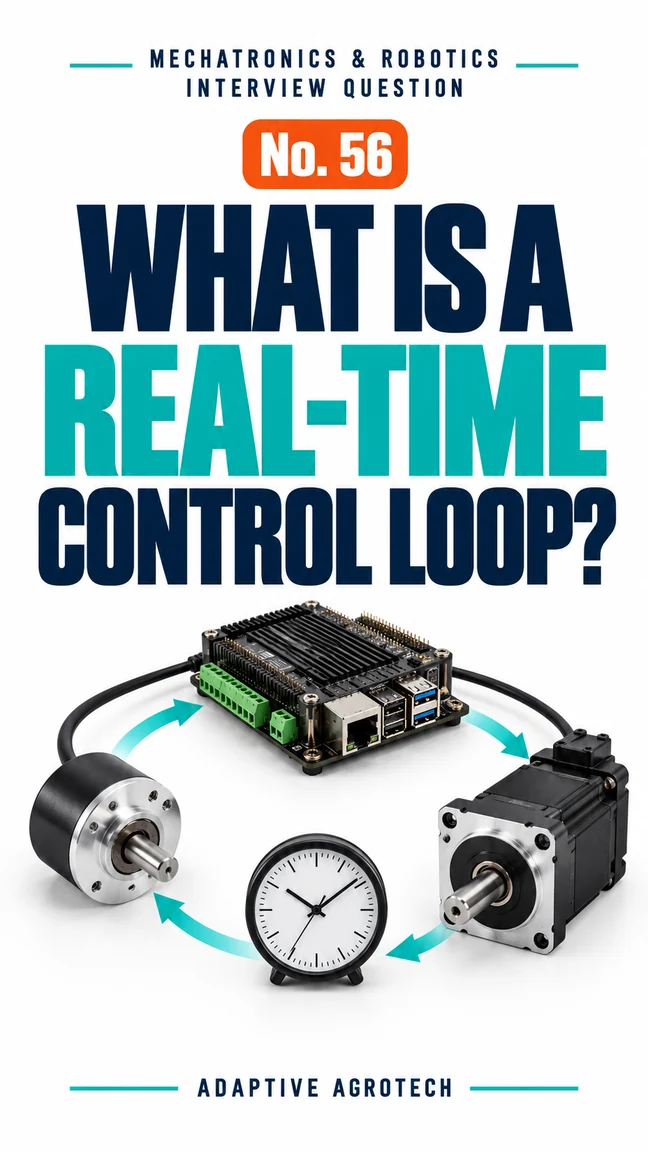
What is a Real-Time Control Loop?

Real-time control requires completion before a defined deadline rather than merely good average speed. Sensor acquisition, computation, and output share the timing budget, and worst-case delay and jitter determine whether the chain meets it.

Watch & explore
Localization & estimationNo. 060

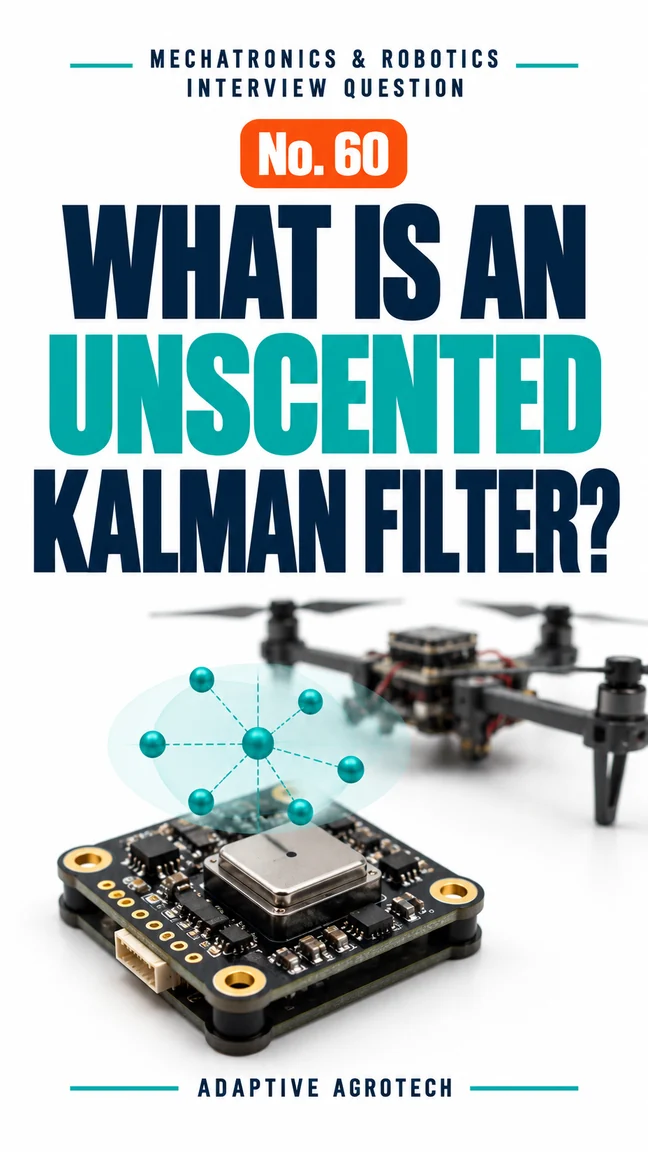
What is an Unscented Kalman Filter?

The UKF represents mean and covariance with weighted sigma points and transforms them through nonlinear models. It avoids Jacobian calculation and can capture nonlinear effects, while retaining computational, noise-model, and tuning requirements.

Watch & explore
Localization & estimationNo. 061

What is a Particle Filter?

A particle filter represents localization with many weighted pose hypotheses. Motion moves them, measurements score them, and resampling focuses computation on plausible alternatives, with particle count controlling hypothesis retention and resource demand.

Watch & explore
Motion planningNo. 084

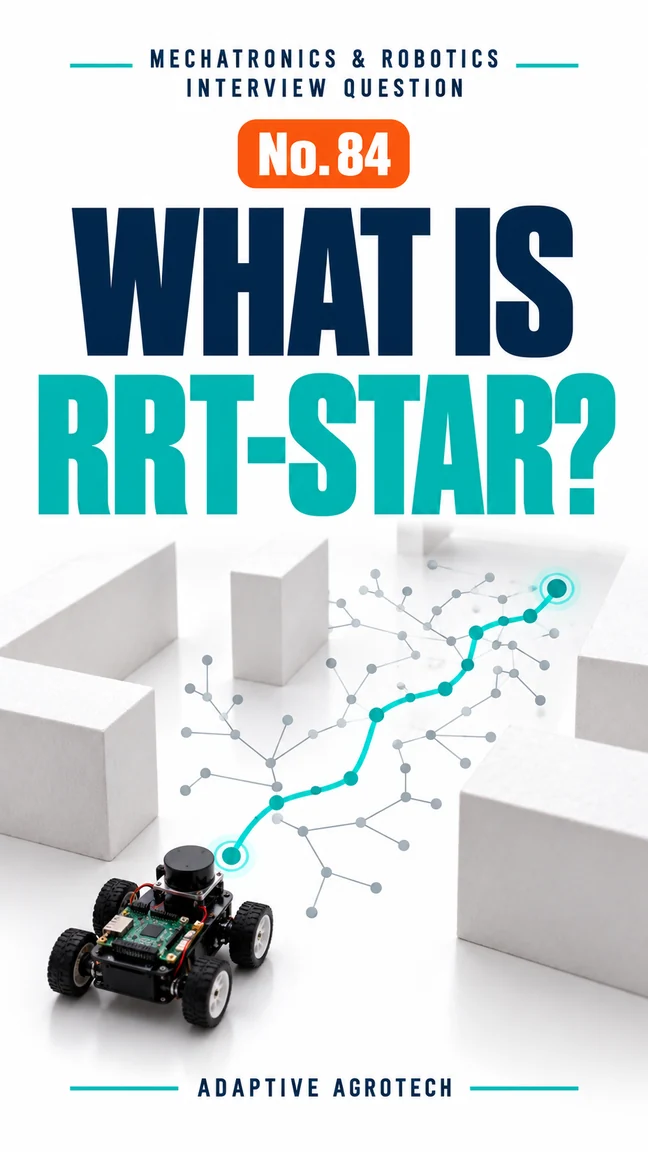
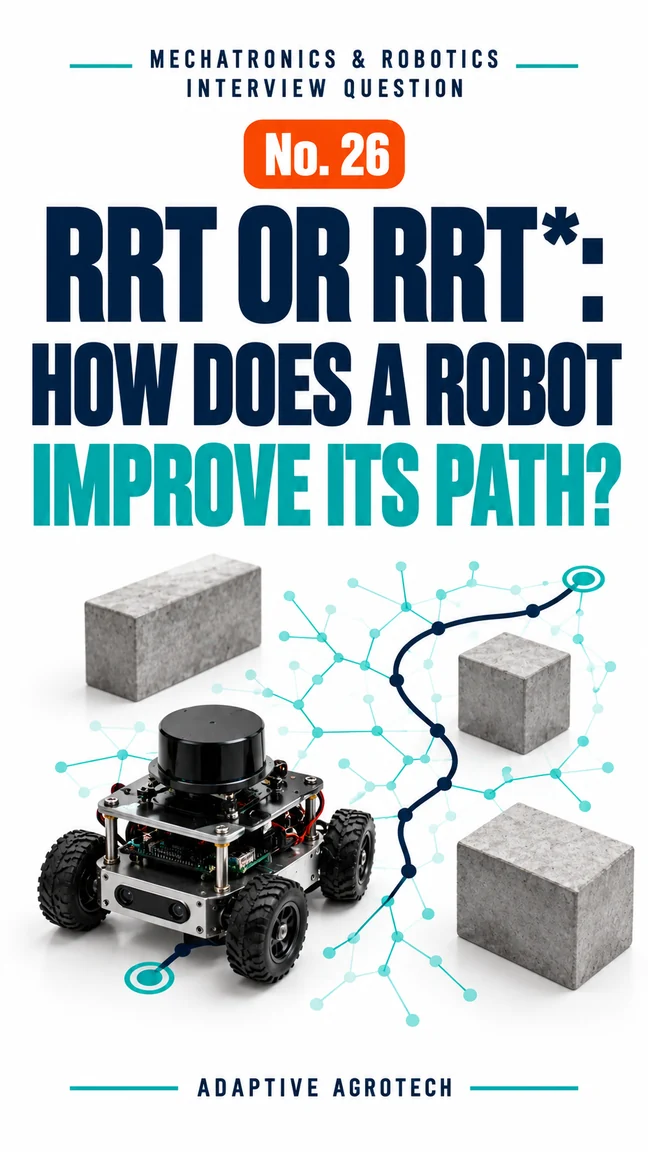
What is RRT-Star?

RRT* improves a sampled search tree by choosing lower cost parents and rewiring nearby connections. Continued search can reduce path cost, while asymptotic optimality does not guarantee an exact optimum in a short run.

Watch & explore
Embedded electronicsNo. 134

What is a Real-Time Operating System?

An RTOS schedules software around timing requirements, where a late result can be incorrect for the task. Priorities and sleeping tasks help, but complete deadlines still require execution and blocking analysis under load.

Watch & explore
Control systemsNo. 168

What Are Gain Margin and Phase Margin?

Gain and phase margins describe how a loop can change before reaching a stability boundary. For standard negative feedback, phase margin is measured at unity loop gain. Gain margin uses the minus one hundred eighty degree phase crossover.

Watch & explore
Control systemsNo. 172

What Is a Zero-Order Hold?

A zero order hold keeps each sampled command constant until the next update. Its output is a staircase. It does not draw a straight line between samples or predict the next command.

Watch & explore
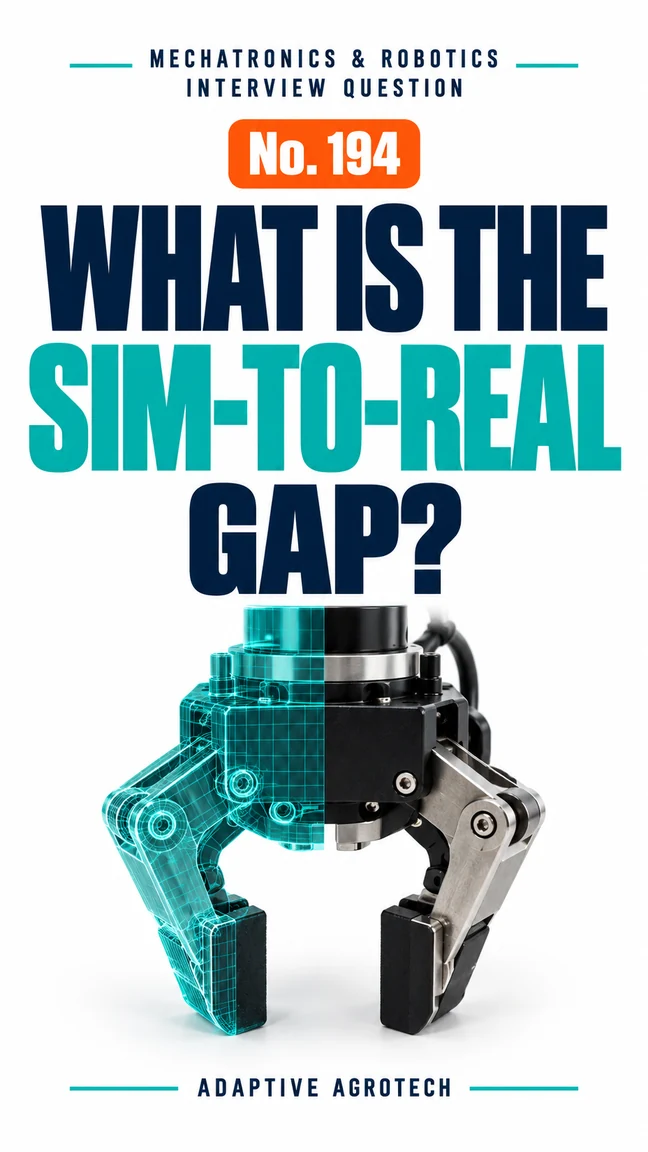
AI & machine learningNo. 194

What Is the Sim-to-Real Gap?

The sim to real gap is the mismatch between simulated training conditions and the physical robot. Differences in contact, friction, sensing, actuator response, and timing can change the consequences of the very same command.

Watch & explore
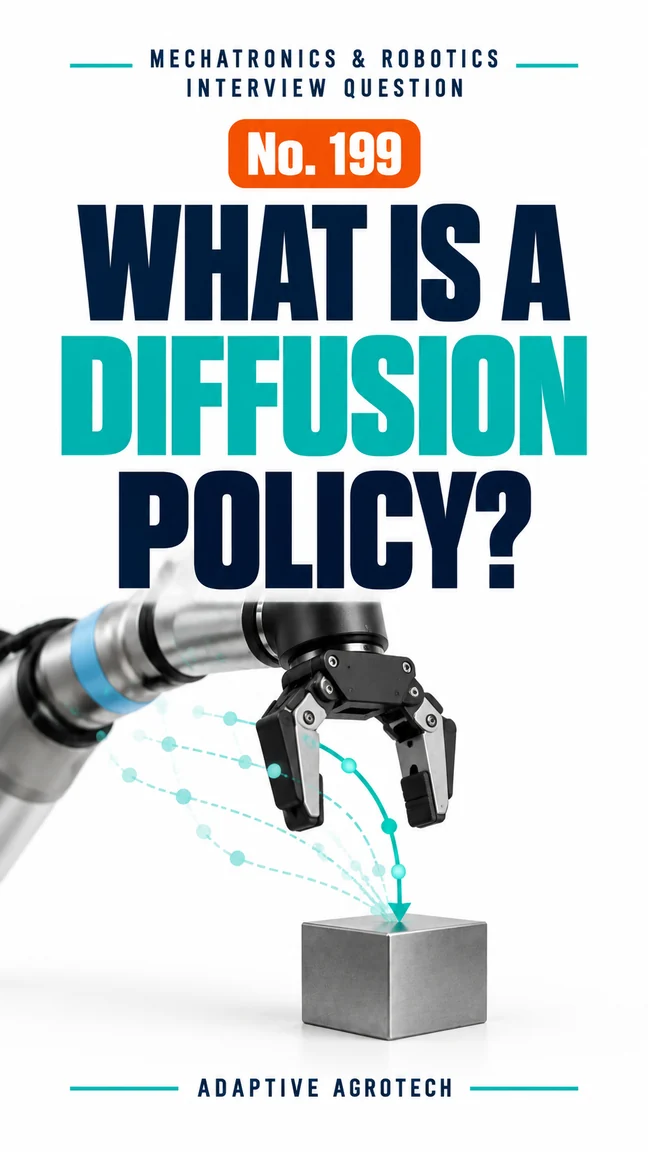
AI & machine learningNo. 199

What Is a Diffusion Policy?

A diffusion policy learns to generate robot action sequences by gradually removing noise. During inference, observations condition this process, so an initially noisy sequence becomes a candidate movement consistent with the learned demonstrations.

Watch & explore